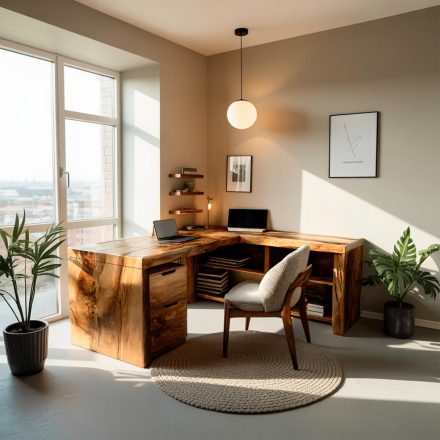
Tiny House Desk: How to Design a Workspace That Actually Works
Living small isn’t the challenge — designing badly is. A tiny house desk must earn its footprint. Most people approach this like furniture shopping. The truth? It’s actually spatial design.
Table Of Content
- 1. The Three Types of Tiny House Desk That Actually Work
- 2. Depth Matters More Than Width (Especially for a Tiny House Computer Desk)
- 3. Visual Weight Is Everything in a Small Space
- 4. Cable Management Is Non-Negotiable in a Tiny House Desk
- 5. What Tiny House Desks Can Learn from Japanese Interiors
- 6. Tiny House Desk Ideas That Don’t Feel Temporary
Whether you’re working from home, gaming, or pursuing creative projects, the way you plan a desk in a tiny house dictates both comfort and productivity. In this guide, we’ll explore practical strategies for designing a tiny house desk that doesn’t just exist, but actually works.
1. The Three Types of Tiny House Desk That Actually Work
When thinking about tiny house desk setups, start with structure, not style. Your choice of desk fundamentally shapes how functional the space will be. Here are the three most effective types:
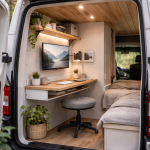
- Floating Wall-Mounted Desk – Keeps the floor clear and creates the illusion of space. Perfect for narrow rooms.
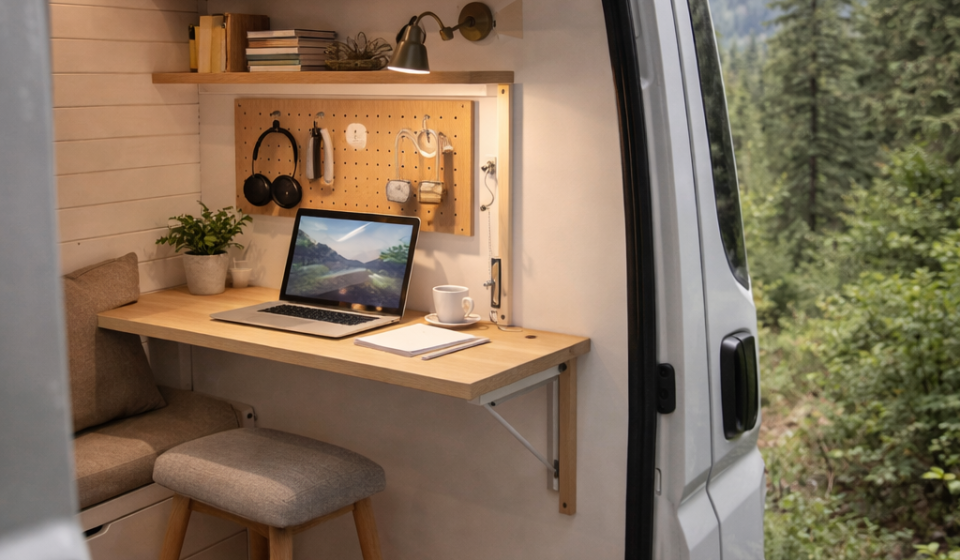
- Fold-Down (Murphy-Style) Desk – A desk that disappears when not in use; ideal for multi-purpose rooms.
- Built-In Bench + Desk Hybrid – Combines seating and work surface in one compact unit, maximising efficiency.
Looking for tiny house desk ideas? These articles lend themselves to any small desk space.
Internal links:
2. Depth Matters More Than Width (Especially for a Tiny House Computer Desk)
Most tiny house computer desk setups fail because they’re too shallow to function. Pinterest images may look spacious, but a desk that’s too narrow compromises comfort and usability.
- 40cm vs 60cm depth: Aim for a minimum of 60cm if you’re using a monitor and keyboard.
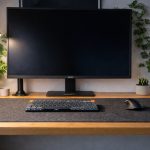
- Monitor arm vs fixed stand: Arm-mounted monitors save valuable desk space and improve ergonomics.
- Keyboard clearance: Ensure elbows can rest at 90° without bumping knees or walls.
- Knee space minimums: Even in tight rooms, allow at least 60cm of knee clearance for comfort.
These small tweaks make the difference between a “cute” desk and one you actually enjoy using.
3. Visual Weight Is Everything in a Small Space
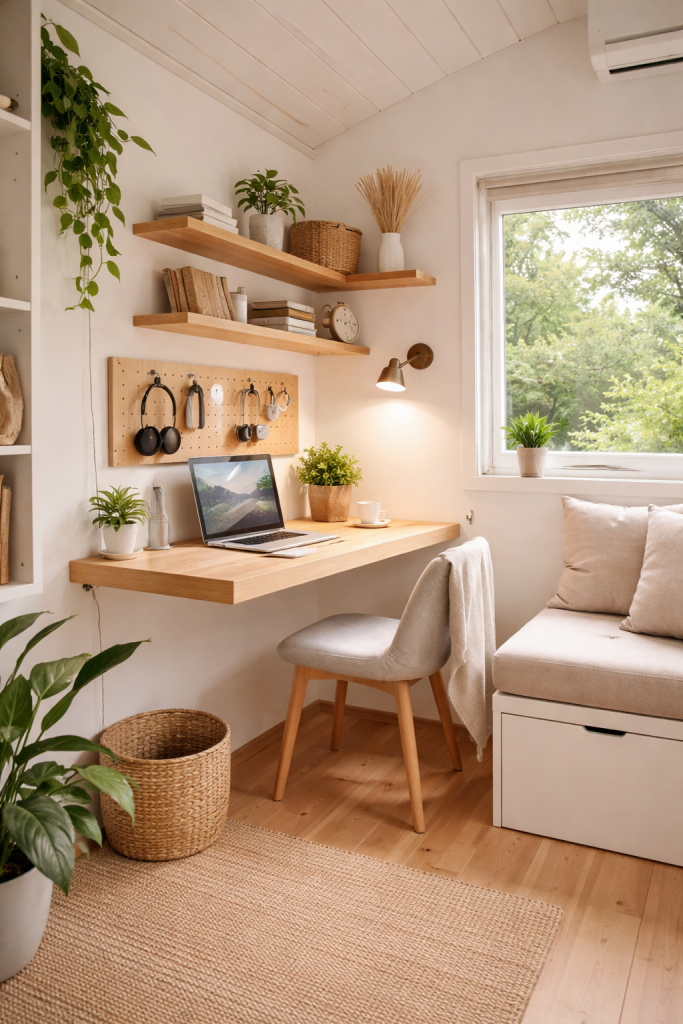
In tiny homes, how a desk feels matters as much as how it functions. Light, airy, and leggy furniture tends to feel less oppressive than boxy, bulky designs.
- Leggy vs boxy furniture: Choose designs with exposed legs or minimal structure.
- Wall colour blending: Desks that match the wall reduce visual clutter.
- Floating shelves: Adds storage without eating floor space.
- Vertical storage: Draw the eye upward, maximising perceived space.
These strategies tie naturally to our Make a Desk Feel Bigger approach, reinforcing your authority on compact workspace design.
4. Cable Management Is Non-Negotiable in a Tiny House Desk
In a tiny house, every visible cable doubles the visual clutter. Poor cable management can instantly ruin a clean, minimal setup.
- Mount power strips to desk backs: Keeps plugs hidden but accessible.
- Slim trunking: Guides cords neatly along walls or under desks.
- Under-desk trays: Keep chargers, adaptors, and cables out of sight but easy to reach.
Internal link: Hide Desk Cables
5. What Tiny House Desks Can Learn from Japanese Interiors
Japanese design excels in tiny desk minimalism without feeling austere. Applying some of these principles elevates your space beyond mere function:
- Built-in minimalism: Surfaces are uncluttered, with items stored away.
- Multi-use surfaces: Every object earns its place — a desk can double as dining or crafting space.
- Low visual noise: Simple lines, neutral colours, and natural materials.
- Natural materials: Wood, bamboo, or stone surfaces feel spacious and tactile.
Using these cues, your tiny house desk becomes a statement of thoughtful design rather than temporary practicality.
6. Tiny House Desk Ideas That Don’t Feel Temporary
Finally, small spaces need longevity. Here are ideas that combine practicality with style, so your desk setup doesn’t feel like a temporary fix:
- Fold-away lighting zones: Task lights that retract or hide when not in use.
- Desk that disappears when not in use: Fold-down or rolling designs.
- One-object rule: Every accessory should serve a purpose.
- Vertical plant accent: Adds life and texture without taking up precious floor space.
These tiny house desk ideas prove that small can be both functional and inspiring.