Make Your Desk Feel Bigger Without Buying a Bigger Desk
A desk doesn’t have to be physically bigger to feel better.
Table Of Content
If your desk feels cramped, overwhelming, or strangely tiring to work at, the problem often isn’t how much you own — it’s how the space is being perceived. Small desks amplify visual mistakes. Every object sits closer to your eye line, every interruption feels louder, and every poor layout choice eats into your sense of calm.
This article isn’t about owning less or starting again. It’s about changing how your desk feels using simple, design-level decisions that work even when space is limited.
Why Small Desks Feel Cramped (Even When They’re Tidy)
A desk can be technically tidy and still feel boxed in.
That’s because our brains don’t measure space in centimetres — they read edges, depth, and visual weight. When everything sits flat, crowded, or visually heavy, the desk surface feels compressed, regardless of how organised it is.
This is why purely organisational fixes don’t always solve the problem. You can line everything up neatly and still feel like the desk is closing in on you.
(If you’re still deciding what belongs on your desk in the first place, start there first →
👉 Minimalist Desk Setup Checklist for a Focused Workspace)
This article assumes you’re already working within limits — now we’re improving perception.
Use Vertical Space to Free the Desk Surface
When horizontal space is tight, vertical space becomes your best ally.
Raising elements off the desk surface immediately creates the feeling of more room, even though nothing has technically changed. The eye reads layers as depth — flat planes feel compressed, stacked planes feel spacious.
Simple examples:
- Elevating your screen
- Lifting a lamp rather than letting it sprawl
- Allowing negative space beneath key items
The goal isn’t to add height everywhere — it’s to avoid everything fighting for the same visual plane.
Create Clear Edges and Sight Lines
One of the fastest ways to make a desk feel smaller is by blocking its edges.
When cables spill over the sides, objects overhang the front, or items blur the desk’s outline, your brain stops recognising the desk as a defined shape. It feels heavier and more cluttered than it actually is.
Clear edges give the eye somewhere to rest. They also make the desk surface feel wider and calmer.
If cables are breaking those visual lines, that’s not just a tidiness issue — it’s a spatial one.
👉 Hide Desk Cables Like a Designer: Simple Ideas for an Organised Setup
Reduce Visual Weight, Not Function
This is where many people instinctively reach for decluttering — but that’s not always necessary.
Instead of removing items, think about visual weight:
- Darker objects feel heavier
- Scattered items feel busier than grouped ones
- Inconsistent materials pull attention
A few well-balanced groupings will feel lighter than many isolated objects, even if the item count is the same. The desk starts to feel intentional rather than crowded.
This is about balance, not minimalism.
Light and Depth Are the Fastest Wins
Lighting has a disproportionate effect on how big a desk feels.
Flat, overhead lighting tends to compress a space. Directional or side lighting introduces shadow and depth, which immediately makes the area feel more three-dimensional.
Good lighting:
- Separates objects visually
- Creates depth cues
- Reduces that boxed-in feeling
If your desk feels tight late in the day, lighting is often the culprit.
👉 Workspace Lighting: How to Design Lighting That Helps You Focus
One Anchor Point Is Enough
Small desks don’t need multiple focal points.
When too many items compete for attention, the desk feels visually noisy and flat. One deliberate anchor — something that grounds the space — gives everything else permission to be quieter.
This might be:
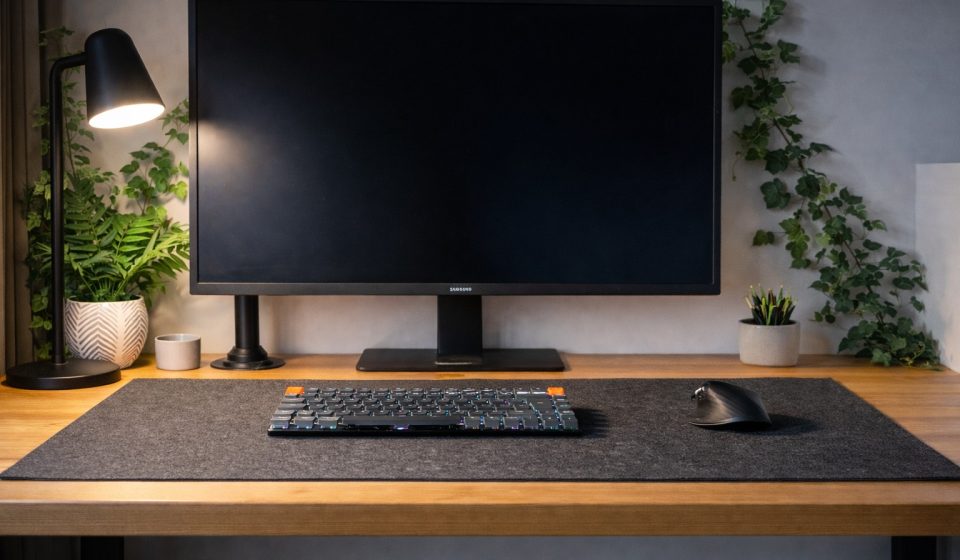
- A single plant
- A lamp with presence
- A carefully chosen object that adds calm
The mistake isn’t having personality on a desk — it’s having too many competing anchors.
A Desk Doesn’t Need to Be Bigger to Feel Better
When a desk feels cramped, the instinct is often to remove more, buy more, or start again. But in most cases, the fix is simpler — clearer edges, better depth, lighter visual weight, and more deliberate structure.
A small desk can feel calm, spacious, and focused without changing its footprint at all. It just needs design decisions that respect how we actually perceive space.