Biophilic Office Design: Bringing Nature Into a Considered Workspace
There’s a particular kind of desk that feels alive. Not because of anything digital happening on the screen, but because of what’s around it — a patch of morning light, the grain of real wood, a plant leaning in over the keyboard. That’s the essence of biophilic office design, and it’s less a trend than a return to something obvious: humans work better near nature, even a small, deliberate slice of it.
Table Of Content
- What Biophilic Office Design Actually Means
- Why It Affects Focus, Not Just Aesthetics
- Bringing Biophilic Design Into a Home Office
- Light
- Plants
- Natural Materials
- Layout and Outlook in Biophilic Office Design
- Our Own Setup as a Working Example
- Common Biophilic Office Design Mistakes to Avoid
- A Considered Approach, Not a Checklist
For us, this wasn’t a strategy we sat down and planned. It happened somewhere in between — a scaffolding wood desktop chosen for its texture and story, a plant added because the desk felt bare, warm lighting swapped in because the overhead bulb felt clinical. It was only later, looking at the finished setup, that we realised it had a name.
What Biophilic Office Design Actually Means
The term gets thrown around loosely, often reduced to “put a plant on your desk.” That’s part of it, but biophilic design is really about reintroducing the natural elements our brains are wired to respond to:
- Light — natural or warm-toned, rather than flat overhead white
- Greenery — living plants, not just their aesthetic but their presence
- Natural materials — wood, stone, linen, anything with texture and imperfection
- Airflow and outlook — a window, a view, a sense of space beyond the screen
- Organic shape and texture — surfaces that aren’t uniformly smooth or synthetic
None of these need to be dramatic. A single well-placed plant and a warmer bulb can shift a desk from sterile to genuinely calming. The point isn’t abundance, it’s intention — choosing natural elements because they change how a space feels to sit in, not because they photograph well.
Why It Affects Focus, Not Just Aesthetics
This isn’t just a design preference — there’s a practical case for it too. Research on biophilic workplaces has consistently linked greener, more natural environments to higher reported wellbeing and creativity among workers. Desks that feel closer to nature tend to reduce the low-level mental fatigue that comes from staring at flat, artificial surroundings all day. A green, textured, warmly lit corner gives the eyes and mind somewhere to rest between tasks, which matters more than it sounds when you’re at a screen for hours.
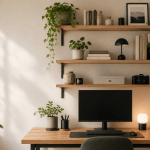
We’ve noticed this directly with our own setup. Having something green and alive on the desk has a genuinely calming effect — it’s not decorative, it changes the tone of the room. An overhanging plant in particular brings a kind of cosiness that a purely functional desk doesn’t have, however well organised it is.
Bringing Biophilic Design Into a Home Office
Light
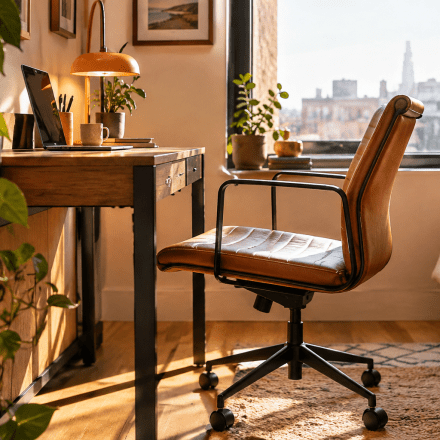
Start here before anything else. If you have access to a window, position the desk to use it — not necessarily facing it, which can cause glare, but near enough to benefit from the shift in natural light through the day. Where that’s not possible, warm-toned lamps do a lot of the same work. Cold white light reads as clinical; warmer tones feel closer to daylight and evening light, both of which the body responds to more naturally.
Plants
One well-chosen plant will do more than several small, forgettable ones. Overhanging or trailing plants add a sense of enclosure and cosiness that upright plants don’t — they soften the hard edges of a desk setup in a way that’s hard to replicate with anything else. The plant doesn’t need to be large. It needs to be visible from where you actually sit.

Natural Materials
This is where texture matters more than colour. A desk surface with real grain, a woven mat, a stone coaster — these small material choices break up the uniformity of screens, cables and plastic accessories. They don’t need to dominate the setup, just interrupt it.
Layout and Outlook in Biophilic Office Design
If you can position your desk with a view — even a modest one, out to a garden or street — it’s worth prioritising over a wall-facing setup. If a view isn’t available, natural materials and greenery can partly substitute, giving the eyes something organic to land on instead of a blank wall.
Our Own Setup as a Working Example
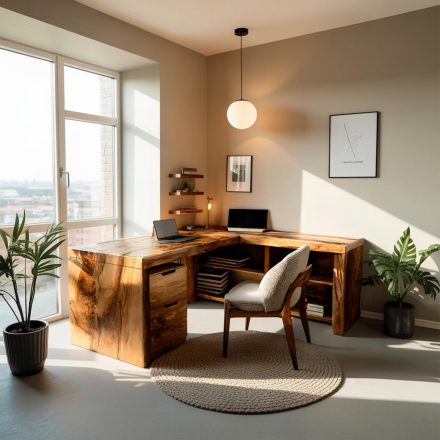
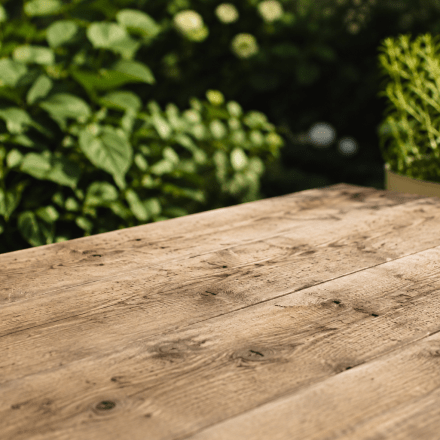
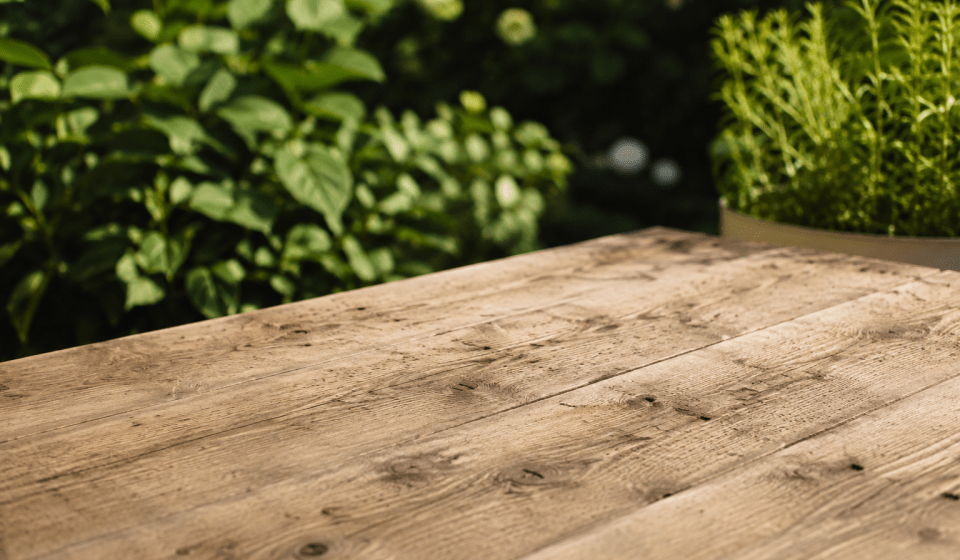
Our desk is built around a repurposed scaffolding wood top — reclaimed, imperfect, with visible grain and marks that a factory desk simply doesn’t have. It sits under warm lighting rather than anything cold or overhead, and a fig tree occupies the corner of the room, tall enough to be part of the visual field without crowding the desk itself.

None of this was assembled as a finished “biophilic office” from day one. The wood came first, chosen for character rather than any design theory. The plant came later, added because the desk felt incomplete without something living in view. The lighting changed last, once the contrast between the warm wood and a cold bulb became obvious. It built up in stages — which is probably closer to how most people actually arrive at a considered desk setup than any top-down plan.
Common Biophilic Office Design Mistakes to Avoid
Overdoing it. A desk crowded with plants and natural textures can tip into clutter, which undoes the calming effect entirely. Biophilic design works through restraint, not volume.
Choosing plants for looks over light conditions. A plant that struggles in low light will look worse over time than no plant at all. Match the plant to the actual light your desk gets, not the light you wish it had.
Ignoring materials in favour of greenery alone. Plants get most of the attention, but texture and material do a lot of the quiet work. A desk with one plant and a wood or linen surface will often feel more grounded than one with several plants on an otherwise synthetic setup.
A Considered Approach, Not a Checklist
Biophilic design isn’t about ticking off light, plants, wood and a view until a space qualifies. It’s closer to a way of noticing what a desk is missing — usually something alive, something textured, something that isn’t screen or plastic — and addressing that gradually. Ours came together this way, piece by piece, and it’s still the small green, overhanging detail that does the most to make the desk feel like somewhere worth sitting down at.