Desk Chair for Small Spaces: Ergonomics Meets Minimal Design
A desk chair for small spaces isn’t just another purchase. If you’re working from a compact office — whether that’s a 7×10ft spare room, an under-stairs nook, or a corner of your bedroom — your chair is probably the one piece of furniture that absolutely cannot be an afterthought.
Table Of Content
- Why This Matters: Sitting Is Your Job Now
- The Small-Space Constraint: What Doesn’t Work
- What Actually Matters in a Desk Chair for Small Spaces
- Chair Height (And Why It’s Everything)
- Footprint, Not Bulk
- Ergonomics That Actually Fit You
- Aesthetics As Infrastructure
- The Budget Question: Investment vs. Cost
- How to Choose a Desk Chair for Small Spaces: A Framework
- 1. Test It First (If Possible)
- 2. Prioritise Based on Your Day
- 3. Measure Your Space (Really)
- 4. Accept One Trade-Off (Or Don’t)
- Connecting It Back to Your Space
- Making the Leap: Choosing Your Desk Chair for Small Spaces
Here’s the truth: when you’re sitting 8–10 hours a day, your chair stops being décor. It becomes infrastructure.
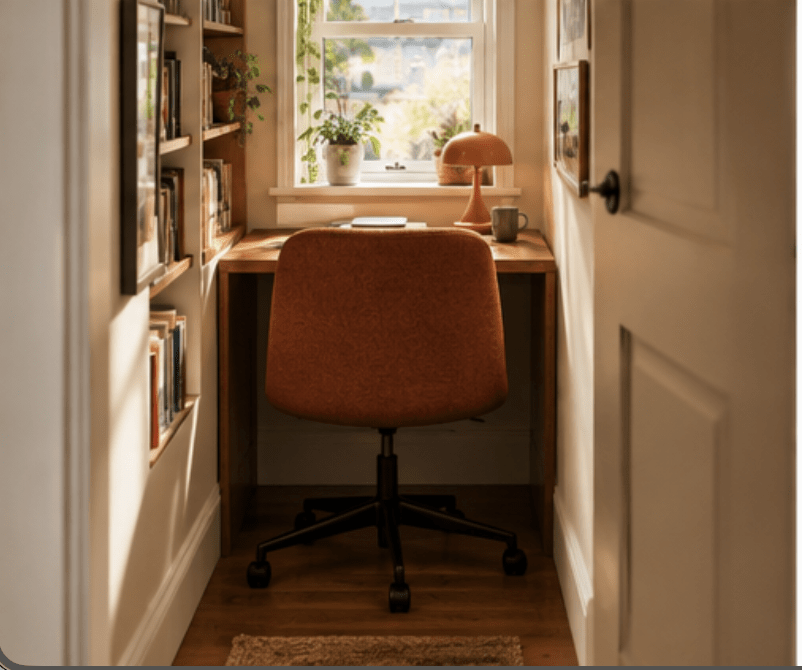
Most conversations about small-space offices focus on the desk — the right dimensions, cable management, whether to go wall-mounted. But the chair is where the real tension lives. You need something that supports your body through a full working day, doesn’t dominate your limited floor space, and doesn’t look like you’ve dropped a gaming rig or corporate cubicle into your carefully considered minimal setup.
Finding a desk chair for small spaces that ticks all three boxes is the overlooked challenge. And it’s worth solving properly.
Why This Matters: Sitting Is Your Job Now
When you’re working from home, especially in a constrained space, your chair is where you spend the majority of your day. Eight, nine, ten hours — sometimes more.
A lot of people treat this as a cost problem: buy the cheapest chair that doesn’t actively hurt, and move on. But research on the health risks of prolonged sitting shows that after a year of sitting in something uncomfortable, the cost becomes physical — back ache, neck tension, the slow accumulation of poor posture.
The counterintuitive bit: investing in a proper chair for your small space isn’t a luxury decision. It’s a health decision disguised as a furniture choice.
Shoulder and neck discomfort after a long day has made me think more about my posture — and realise that the solid desk chair I’m living with is very basic. It wasn’t a sudden failure. It was the slow recognition that something I use for 8–10 hours daily probably deserves more intentionality than “whatever was available at IKEA when I moved in.”
The Small-Space Constraint: What Doesn’t Work
Before we talk about solutions, let’s be clear about what fails in a tiny office.
Oversized executive chairs. The kind with tall backs, wide armrests, and a massive 5-star base. They look absurd in a compact room. They consume floor space when you roll back. They make the room feel smaller by proportion.
Chairs with deep recline mechanisms. Nice feature if you’ve got space to recline. Useless — and space-stealing — when your chair is three feet from the opposite wall.
Wide-frame designs. Armrests that stick out 8 inches on each side. Footrests that demand legroom. These are comfort features for office environments where space is unlimited. They’re traps in small rooms.
The real insight: Most desk chairs are designed for spaces that have room to breathe. Small-space offices don’t.
What Actually Matters in a Desk Chair for Small Spaces
If a chair doesn’t work for your body, it doesn’t matter how minimal it is. But if it works for your body and respects your space, you’ve solved something genuinely difficult.
Here’s what we’ve learned matters most:
Chair Height (And Why It’s Everything)
This is the most underrated factor in small-space seating.
A chair that’s too tall makes you feel hemmed in. It raises your eye line closer to the ceiling. It visually crowds the room. A chair that’s the right height — where your feet sit flat on the floor, elbows at roughly 90 degrees when typing — almost disappears.
It’s not just ergonomic. It’s spatial.
Footprint, Not Bulk
The chair’s physical footprint — how much floor space it claims when you sit — matters more than how “heavy” it looks.
A slimline chair with minimal armrests and a compact base can feel lighter and less intrusive than a bulky design, even if they’re technically similar in size.
We look for:
- Narrow armrests (or none)
- A smaller 5-star base (not spread wide)
- A backrest that doesn’t extend much beyond your shoulders
These don’t compromise comfort. They just respect your room.
Ergonomics That Actually Fit You
This is where most small-space chair shopping fails.
People assume: “Small space = compromise on comfort. I’ll just get whatever fits.”
Wrong. You’re sitting in this chair 8–10 hours daily. Compromising on ergonomics will cost you in back pain, posture degradation, and genuine discomfort.
The trick is finding a desk chair for small spaces with genuine ergonomic design This is rare, which is why it’s worth investing when you find it. Understanding what makes ergonomic chair design effective — features like spinal support, adjustability, breathability, and extremity support — helps you spot the difference between a cheap chair and one actually built to support your body.
Sitting in a properly designed chair at John Lewis made me realise how intentional ergonomic design actually is — every groove has purpose, every angle positions you correctly. It became clear that ergonomics and small-space aesthetics don’t have to be enemies. It just means being intentional about which chair you choose, rather than defaulting to the cheapest option.
Aesthetics As Infrastructure
This might sound superficial, but it isn’t.
Your office’s visual atmosphere affects your focus and mood. A chair that clashes with your space — that looks borrowed from somewhere else, or feels oversized — creates low-level friction every time you sit down.
A chair that belongs in your minimal setup doesn’t just look right. It feels right. You relax into it, literally and psychologically.
This is why we talk about workspace design at Deskfully: because design isn’t decoration. It’s the foundation your work sits on.
The Budget Question: Investment vs. Cost
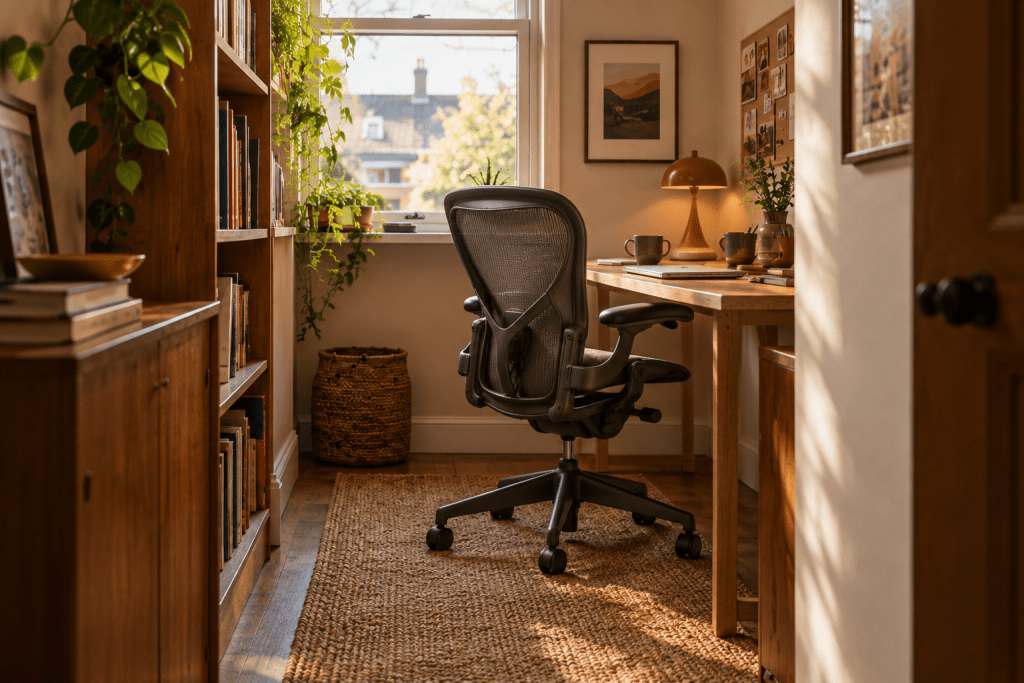
Here’s the conversation most people skip.
“I can get a basic chair for £150. Or I can spend £600+ on something proper. Over how many years does that investment break even?”
The math people usually do: £600 ÷ £150 = 4 years. So it’s worth it if you use the chair for 4+ years.
But that’s incomplete math. It misses the actual value.
If you’re sitting 8–10 hours a day, that chair is in use roughly 2,000 hours per year. Over 5 years, that’s 10,000 hours.
A £600 chair costs £0.06 per hour of use.
A £150 chair that causes back ache, poor posture, and genuine discomfort? That’s not cheaper. It’s just hiding the cost until it becomes physical.
After thinking about what my desk setup was missing, I realised I tend to stay minimal. So I looked elsewhere — somewhere that might not be an aesthetic improvement, but was a genuine health decision. The shift wasn’t about upgrading the look. It was about admitting that the chair I’d been using wasn’t serving me anymore, and that’s okay.
The reframe: When you spend this much time in something, the investment isn’t extravagant. It’s obvious.
How to Choose a Desk Chair for Small Spaces: A Framework
If you’re shopping for a desk chair for small spaces, here’s a practical filter:
1. Test It First (If Possible)
This matters more than specs.
Go to a showroom if you can. Sit in it. Roll back. Check if your feet sit flat. Adjust the height. Notice how it feels, not just how it looks.
Testing in person reveals things that specs simply can’t. You learn how it actually supports you, how it moves, whether it feels stable or wobbly. And you get a sense of proportion — does this chair feel right in your space, or is it obviously oversized?
2. Prioritise Based on Your Day
You sit 8–10 hours and stand maybe 3 hours a week.
If you’re predominantly seated: ergonomics first, then aesthetics.
If you’re split 50/50 seated and standing: style and comfort become more balanced.
If you’re mostly standing with occasional sitting: you can afford more stylistic flexibility.
Your actual working pattern should dictate your priority. Don’t reverse-engineer it.
3. Measure Your Space (Really)
Know your room dimensions and existing furniture placement. Roll back from your desk. How much space do you actually have? Is it 2 feet? 3 feet?
That matters when you’re choosing a chair base. A wide, splayed base that’s fine in a normal office becomes intrusive when you’ve got limited clearance.
4. Accept One Trade-Off (Or Don’t)
In a small space, you usually make one trade-off. But not always.
Maybe you choose a chair with minimal armrests (style win, minor comfort loss). Or you go premium on ergonomics and the aesthetic is less “wow” (comfort win, style compromise).
The mistake is trying to win on everything. You usually can’t.
But some chairs solve all three — small footprint, proper ergonomics, and minimal aesthetic. They’re rare, which is exactly why they’re worth the investment. It could be argued that aesthetics of a chair don’t stand out to most people anyway. What does stand out is how it feels after 8 hours of work.
Connecting It Back to Your Space
A small tiny-space workspace demands that every piece of furniture earn its place. Your chair is the one piece you’re in constant contact with. It’s not background furniture. It’s active infrastructure.
Proper ergonomic workspace design supports both your body and your focus. When your chair is working well, you stop noticing it. When it’s not, it’s all you notice.
And your chair choice feeds into the broader calm office aesthetic you’re creating. A thoughtfully chosen chair that fits your space creates cohesion. Everything feels intentional, not thrown together.
Making the Leap: Choosing Your Desk Chair for Small Spaces
If you’re sitting in an uncomfortable chair because you’re worried about space or budget, you’re solving the wrong problem.
A properly designed desk chair for small spaces isn’t a contradiction. It’s just rarer than furniture marketed toward standard office environments.
It’s worth the research. It’s worth the test sit. And it’s worth the investment when you realise: this is where you spend a third of your waking hours. Your setup shouldn’t force you to sacrifice your health for aesthetics