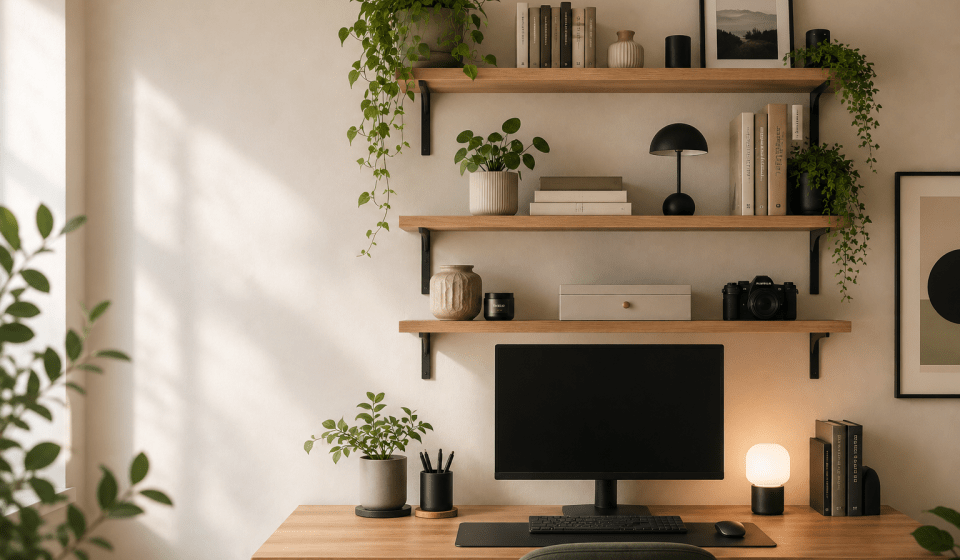
Home Office Shelving Ideas That Stay Organised (And Actually Reflect Who You Are)
Home office shelving ideas have a way of revealing your intentions — the good ones and the ones you hadn’t quite planned for.
Table Of Content
- Why home office shelving ideas matter more than anywhere else
- The clutter problem most home office shelves develop
- What works on home office shelving ideas that last
- The nook effect
- Home office shelving ideas: floating versus freestanding
- What to avoid
- Start your home office shelving ideas with less than you think you need
When it works, it’s one of the most satisfying elements a workspace can have — a wall of books, a few considered objects, some greenery, maybe a lamp tucked into a corner. The kind of shelving that looks like it belongs to a specific person rather than a showroom. Organised without being sterile. Personal without being cluttered.
When it doesn’t work, it becomes something else entirely. A surface that accumulates things without any logic. Papers that were meant to be temporary. Objects without a home. The kind of shelf you stop seeing after a while because looking at it creates a low-level stress you’d rather not deal with.
The difference between the two isn’t really about the shelving itself. It’s about the decisions made around it — what goes on it, what doesn’t, and how much visual breathing room is left between things.
Why home office shelving ideas matter more than anywhere else
In a living room, a cluttered shelf is an aesthetic problem. In a home office, it’s a focus problem.
The things in your peripheral vision during a work session are constantly competing for a small slice of your attention. You don’t consciously register them, but they’re there — a pile of papers, a box that needs dealing with, an object you keep meaning to move. Over a long session, that ambient visual noise adds up.
Well-designed shelving does the opposite. It contains things cleanly, gives the eye somewhere calm to rest during a moment of thinking, and — at its best — adds a quality to the workspace that makes it feel like somewhere worth being. A shelf with books, a plant, and one or two objects chosen with some care feels entirely different to the same shelf filled with things that ended up there by default.
The clutter problem most home office shelves develop
Here’s an honest observation: most home office shelving starts well and deteriorates gradually.
The shelf goes up, things are arranged with care, and for a few weeks it looks exactly as intended. Then a document gets placed there temporarily. Then a charger. Then something that doesn’t have an obvious home elsewhere. Within a few months the shelf that was supposed to bring calm to the workspace has become the thing you avoid looking at.
This is such a common pattern that it’s worth designing around from the outset rather than hoping to avoid it through willpower alone.
The most reliable approach is to decide in advance what the shelf is for — and more importantly, what it isn’t for. A shelf designated for books, plants, and a small number of considered objects has a defined identity that makes it easier to maintain. A shelf with no defined purpose becomes a dumping ground by default, because that’s the path of least resistance.
The same principle applies to storage units. A cabinet with three tiers of shelving sounds like useful storage. Without a clear system for what lives where, it becomes exactly the kind of place where things go to be forgotten — technically organised, practically ignored.
What works on home office shelving ideas that last
The setups that consistently look good and stay that way tend to share a few characteristics.
Books as the backbone
Books are the most forgiving shelving element available. They’re vertical, they group naturally, they add colour and texture without visual noise, and they signal something about the person who owns them. A row of books — not obsessively organised, but not chaotic either — gives a shelf structure that other objects can sit alongside without competing.
The mistake is treating books as decoration rather than as things you actually read or reference. A shelf of books chosen for their spines rather than their contents tends to look exactly like that. The shelves that feel most alive are the ones where the books are genuinely used.
Plants at different heights
A shelf with some greenery feels categorically different to one without. Plants introduce a quality that’s hard to manufacture with objects alone — something living, something that changes slightly over time, something that makes the space feel inhabited rather than arranged.
On shelving, height variation matters. A small trailing plant at the edge of an upper shelf, a larger pot sitting on a lower one, a tiny succulent tucked between books — the variation in scale and height creates a layered quality that makes the whole unit feel more interesting without feeling busier.
One or two personal objects — no more
This is where personality enters the equation, and it’s worth getting the balance right. A shelf that reflects nothing about the person using the workspace feels impersonal and slightly sterile. A shelf with too many personal objects — souvenirs, trinkets, things accumulated over time without any editing — tips into visual noise.
One or two objects chosen deliberately make a shelf feel like it belongs to someone. A small sculpture, a camera, an object brought back from somewhere meaningful. The specificity is what makes it work. Anything that could belong to anyone doesn’t add much. Things that could only belong to you do.
Ambient lighting where it fits
A shelf with some form of lighting — small spotlights above, LED strips along the back edge, a lamp sitting on one of the tiers — has a warmth that unlit shelving simply doesn’t. This is particularly effective in the evening, when a softly lit shelf becomes a calm background presence rather than a flat surface of objects.
If the shelving sits above or beside a desk, this lighting can also double as ambient fill light for the workspace — softening the overall light quality without adding another dedicated lamp to the desk surface.
The nook effect
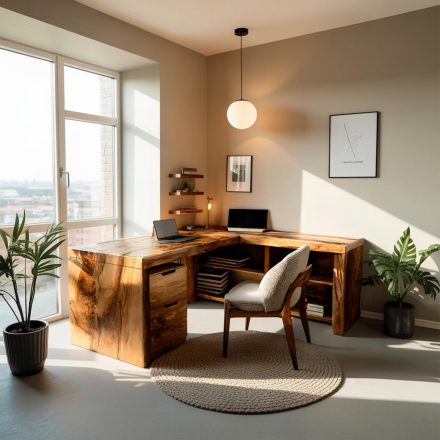
There’s a reason that desk setups built into shelving nooks consistently look so good. The shelving on either side or above creates a sense of enclosure — a defined space within the room that feels like it belongs to the work happening there. The desk isn’t just a surface in a room; it’s a contained environment with its own atmosphere.
You don’t need built-in shelving to achieve something close to this. A freestanding unit positioned to one side of a desk, or a wall-mounted shelf running above it, creates a similar sense of definition. The desk starts to feel like it occupies a zone rather than just a corner.
The key is keeping whatever surrounds the desk calm enough that it adds to the sense of focus rather than competing with it. A beautifully arranged shelf to the left of a desk is a quiet presence. A chaotic one is a distraction in the peripheral vision for every hour you spend there.
Home office shelving ideas: floating versus freestanding
Both have their place, and the right choice depends on the space.
Floating or wall-mounted shelves have a lightness that freestanding units can’t replicate. Because they appear to have no weight — no visible supports, no legs, no bulk at the base — they make a room feel more open even when they’re carrying a reasonable amount. They also give you complete control over height and spacing, which matters when you’re designing around a specific desk or room layout.
The drawback is permanence. Wall-mounted shelving involves fixings, potentially some damage to the wall, and a commitment to the position that’s harder to reverse than simply moving a freestanding unit. In rented spaces this is a real consideration.
Freestanding units offer flexibility and, at their best, a furniture quality that wall-mounted shelves lack. A solid wood shelving unit with some weight and presence can anchor a room in a way that floating shelves — however elegant — don’t quite manage. The key is choosing something with proportions that suit the space: thin legs that lift the unit off the floor rather than a heavy base that sits squat and visually weighted.
What to avoid
A few things that consistently make home office shelving worse rather than better:
Matching sets of decorative objects in threes. This looks like a styling decision made for a catalogue rather than a real workspace and tends to age quickly.
Paper on shelves. Documents, folders, and anything work-related that spills onto shelving immediately makes the whole unit feel like an overflow zone. If paperwork needs to be stored, it belongs in a dedicated drawer or file — not on a shelf alongside books and plants.
Too many small objects at the same height. Visual rhythm on a shelf comes from variation — height, scale, texture. A row of similarly sized objects at the same level creates a flatness that makes the whole thing feel static.
Shelving that’s too full to breathe. Negative space on a shelf is as important as what’s on it. A shelf packed to capacity has nowhere for the eye to rest. Leave gaps. They’re not wasted space — they’re what makes everything around them look considered.
Start your home office shelving ideas with less than you think you need
The most common shelving mistake is filling everything immediately.
Put up the shelf, add the books, add one plant, add one object, and then live with it for a few weeks before adding anything else. The things that are genuinely missing will make themselves obvious. The things you were planning to add but haven’t yet will either earn their place or reveal themselves as unnecessary.
Shelving that’s been edited over time — where things have been added deliberately and removed when they stopped earning their space — has a quality that immediately-filled shelving rarely achieves. It looks considered because it was. And in a home office, that quality of consideration is exactly what makes the difference between a workspace that supports your focus and one that quietly undermines it.