The Minimalist Home Office: Calm, Functional, and Built Around Real Life
There’s a version of the minimalist home office that exists only on Pinterest. Bone-white walls, a single ceramic mug, a MacBook with nothing plugged into it. It looks pristine and it tells you absolutely nothing about how to work.
Table Of Content
If you’ve landed here frustrated with a cluttered setup that’s accumulated over time — cables that have multiplied, drawers full of things you forgot you owned, surfaces that are never quite clear — that’s the version of minimalism worth talking about. Not the curated aesthetic fantasy, but the deliberate decision to design a workspace around how you actually behave.
Those are two very different things. And the gap between them is where most minimal home office guides fail you.
What a minimalist home office actually means
The most common mistake people make when chasing a minimalist home office is confusing minimal with sparse. They clear everything off the desk, put it in a box somewhere, and end up with a space that looks calm but functions poorly. Within a week, things drift back. The visual noise returns.
Real minimalism in a workspace isn’t about reduction for its own sake. It’s about giving everything a considered home — one that’s close enough to be useful, but out of sight enough not to create distraction.
In practice, this means thinking in layers. What needs to be immediately at hand? What can live one reach away? What can be stored elsewhere entirely?
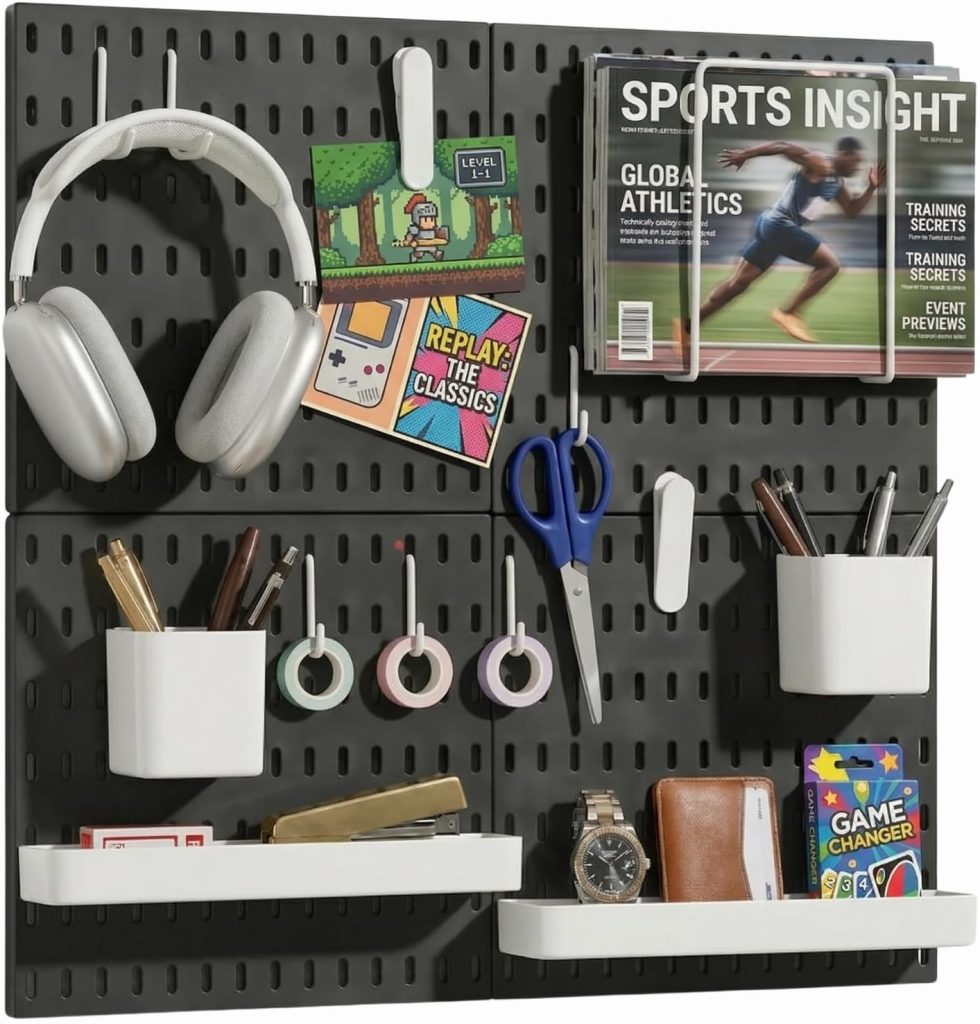
A pegboard is one of the most effective tools for achieving this. On the surface level it looks like a storage solution. What it actually does is convert visual clutter into organised structure — each item has a designated space, visible enough to find quickly, arranged enough not to read as mess. We use the Keepo modular pegboard system on the wall of our own office. The modular panel design means it can grow with your needs, and the layout is flexible enough to genuinely accommodate how the space is used rather than how it looks in a product photo.
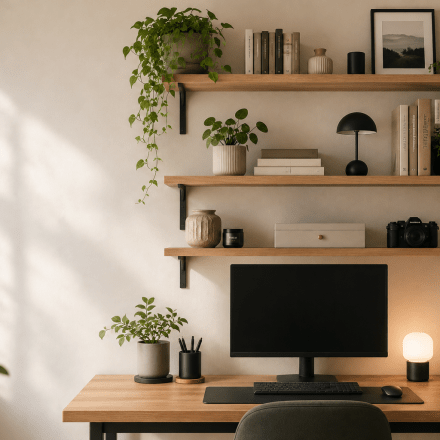
The key detail: the upper shelves are deliberately used for things that are needed less frequently. What sits at eye level is what gets used daily. What goes above is there but not visually dominant. It’s a simple hierarchy, but it makes a significant difference to how calm the space feels.
Design around how you actually behave, not how you wish you behaved
This is probably the most useful thing we can tell you about building a minimalist home office.
Most workspace guides are written for an idealised version of you — disciplined, organised, consistent. The kind of person who already has good habits baked in and just needs the right desk. That person doesn’t need advice. The rest of us need spaces that quietly nudge us toward the behaviours we want, rather than relying on willpower we often don’t have.
A small example: a nail file lives in our office. Not because it’s a piece of work equipment, but because it’s the kind of task that gets neglected indefinitely without a regular environment to anchor it to. It’s there, it’s not in the way, and it gets used. That’s minimal thinking applied honestly — the space serves the life, not the other way round.
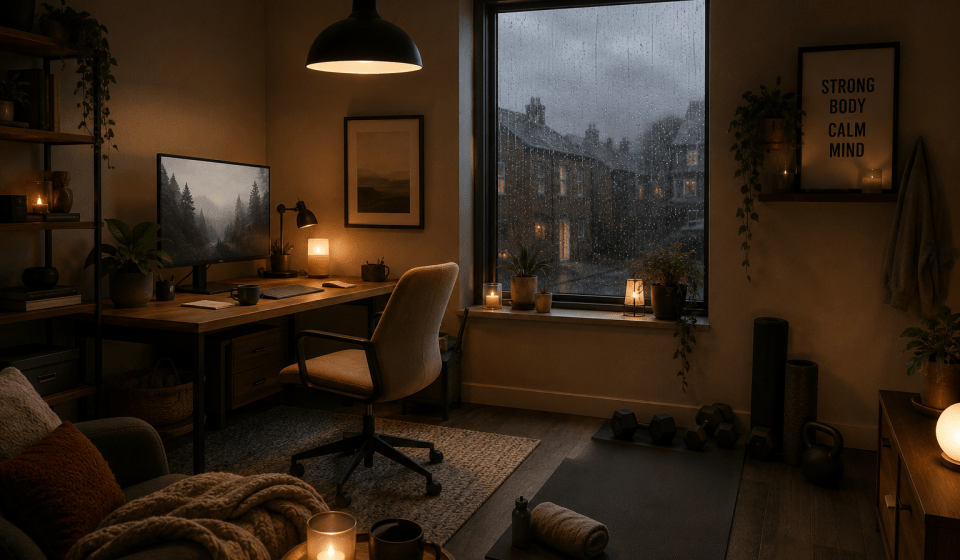
The same logic scales up significantly. One of the deliberate decisions made when setting up this office was preserving enough floor space for a workout mat to roll out fully. Not a symbolic gesture — a considered layout choice that factored in the dimensions of the mat before furniture was positioned. If the room were smaller, or if the desk were positioned differently, that space would be gone.
The result is that a workout happens in the same room as the work, without having to go anywhere, get changed in a separate space, or manufacture motivation against the friction of leaving. When a working day is demanding and motivation is low, a ten-foot walk to a rolled-out mat is a very different proposition to a drive to a gym. We’d accepted a long time ago that the gym, for all its equipment, wasn’t something we’d maintain reliably. Building the space around that honest self-assessment rather than the aspirational one made the difference.
This is minimalism at its most useful: not fewer things, but fewer barriers.
Layered storage for a minimalist home office
For a minimalist home office to function rather than just photograph well, storage needs a clear logic.
The approach that works well in practice involves three distinct zones:
Zone one — the desk surface. This should hold only what’s in active use. A monitor or laptop, something to write with, nothing else by default. If it’s not being used right now, it doesn’t belong on the surface.
Zone two — immediate reach. This is where the pegboard earns its place. Headphones, documents in use, chargers, the small daily-use items that would otherwise accumulate on the desk. Visible, organised, accessible without moving from the chair.
Zone three — stored away. Things used infrequently — a microfibre cloth, a massage gun, anything that’s useful to have in the room but doesn’t need to be in eyeline — live in a drawer or on a shelf elsewhere in the space. Out of sight genuinely does mean out of mind, and that’s a feature, not a flaw.
The logic of these zones means the desk surface stays clear not through discipline but through design. There’s simply no ambiguity about where things go.
Lighting shapes the atmosphere more than any product
A minimalist home office that’s lit badly will never feel calm regardless of how tidy it is. Lighting is the element most people address last and should be addressed first.
The core principle: warmer, layered light creates a more considered atmosphere than a single overhead source. A desk lamp that throws warm light onto the work surface, combined with ambient lighting that softens the room, is a significantly more pleasant environment than a cold overhead bulb doing all the work.
We’ve written in more detail about this in our workspace lighting guide, which covers the practical decisions around colour temperature, positioning, and the difference lighting choices make to focus over the course of a working day.
Plants belong here

A minimalist space isn’t a sterile one. Plants introduce a quality of life to a workspace that objects simply don’t — they’re visually calming, they bring in a material that exists outside the visual language of tech and furniture, and they make a room feel inhabited rather than staged.
The concern people often raise is maintenance. It’s a legitimate one. The solution isn’t to remove plants from the equation but to choose appropriately — low-maintenance varieties that tolerate irregular watering and indirect light perform well in an office environment without requiring much attention. We’ve covered the best options in our guide to office desk plants, including which species actually work in lower-light conditions and which look good in photos but struggle in practice.
A larger floor plant — a fig tree or something with real presence — can anchor a corner of the room in a way that no furniture does, and do it quietly.
Where most people go wrong
Beyond confusing minimal with empty, there are a few consistent mistakes worth calling out.
Organising before editing. Buying storage solutions for a cluttered space just contains the clutter. The first step should always be removing what doesn’t belong in the room at all. Storage comes after that.
Ignoring the floor. A clear desk with a cluttered floor is still a cluttered room. The minimalist home office is a whole-room consideration, not just a desk surface.
Choosing products for how they look rather than how they work. A beautiful notebook that you don’t actually write in, a plant you’ll kill within a month, a lamp that creates glare on your screen — aesthetics matter, but they only work in service of function. The goal is a space that performs as well as it looks.
Treating it as finished. A workspace is a system that evolves. The best minimalist offices are the ones that have been quietly adjusted over time — a cable routed differently, a new hook on the pegboard, a plant moved to catch better light. Small ongoing decisions rather than one dramatic overhaul.
A note on the desk itself
The desk doesn’t have to be expensive or design-led to work well. A sturdy surface at the right height, with enough depth to keep the monitor at a comfortable distance, is the foundation. What matters more is what’s on it — and, more importantly, what isn’t.
If the desk surface is the hardest thing to keep clear, the problem is usually a storage gap somewhere in zones two or three. Something doesn’t have a home, so it ends up on the desk by default. Solving that storage gap — with a pegboard hook, a drawer, a designated shelf — solves the surface problem without requiring any discipline at all.
That’s the quiet logic of a well-designed minimalist home office. Not restraint. Not aesthetics for their own sake. A space that makes the right thing the easy thing, and lets everything else disappear.
If you’re starting from scratch or rethinking an existing setup, our minimalist desk setup checklist walks through the decisions in the order that matters — space and light before products, always.